The Stress Epidemic Nobody in Nepal Is Talking About, And What Science Says You Can Do About It
By Health Spell Nepal | Mental Wellness & Adaptogen Science
It is 9 PM in Kathmandu. A marketing executive is still at her desk, answering emails with a cold cup of chiya beside her. In another part of the city, a young father scrolls through unpaid bills on his phone while his children sleep. A university student in Lalitpur is three weeks behind on assignments, unable to sleep despite being exhausted. None of them would say they have a "mental health problem." They would simply say they are tired, overwhelmed, or stressed , and that this is just how life is.
This quiet, unacknowledged epidemic of chronic stress is not just a feeling. It is a measurable, physiological phenomenon with serious long-term consequences for the body and brain , and Nepal is facing it at scale, with almost no systems in place to address it.
The Numbers Behind Nepal's Stress Crisis
Nepal currently has approximately 3.9 million people living with mental disorders, with major depressive disorders (affecting 1.1 million) and anxiety disorders (affecting 900,000) being the most prevalent conditions, according to findings from the Global Burden of Disease Study 2019 published in Global Mental Health (2023). (Source: PMC , Burden of Mental Disorders in Nepal, 1990–2019)
A nationwide cross-sectional study of Nepalese adults found the age- and gender-adjusted point prevalence of anxiety to be 16.1% , meaning roughly 1 in 6 Nepali adults is experiencing clinically significant anxiety at any given time. (Source: PMC , Anxiety and Depression in Nepal, 2016)
What makes this even more concerning is the treatment gap. Nepal has only 0.17 psychiatrists per 100,000 people , far below the WHO's recommendation of at least one mental health worker per 10,000 population. According to the Kathmandu Post, between 76% and 85% of people with severe mental disorders in low and middle-income countries receive no treatment at all. (Source: Kathmandu Post , Nepal's Mental Health Crisis, 2023)
In practice, this means the overwhelming majority of stressed and anxious Nepali adults are managing , or more accurately, not managing , entirely on their own.

What Chronic Stress Actually Does to Your Body
Stress is not merely psychological. When your brain perceives a threat , whether that is a difficult boss, a financial pressure, traffic in Kathmandu, or a family conflict , it triggers the release of cortisol, your primary stress hormone. In short bursts, cortisol is useful. It sharpens focus, mobilises energy, and prepares the body for action. The problem emerges when stress is chronic. When cortisol levels remain elevated day after day , as is the case for most modern working Nepali adults , the physiological consequences accumulate:

Sleep is disrupted. High evening cortisol prevents the brain from entering deep, restorative sleep, which in turn makes stress harder to manage the next day , a vicious cycle.
The immune system weakens. Prolonged cortisol elevation suppresses immune function, making the body more vulnerable to illness.
Digestive health suffers. The gut-brain axis is highly sensitive to stress hormones; chronic stress is directly linked to irritable bowel, bloating, and appetite dysregulation.
Mood destabilises. Chronically elevated cortisol reduces the activity of serotonin and dopamine , the neurotransmitters responsible for feeling calm, motivated, and positive.
Cognitive function declines. Sustained stress impairs memory, focus, and decision-making , the precise functions that work and life demand most.
Physical pain increases. Muscle tension, headaches, jaw clenching, and back pain are all well-documented physical manifestations of chronic psychological stress.
For Nepali working professionals , navigating traffic, long hours, economic uncertainty, family obligations, and increasingly competitive work environments , this is not a hypothetical description. It is daily life.
Why Most Nepalis Do Not Seek Help
Cultural factors play a significant role in Nepal's mental health treatment gap. Stress and emotional difficulty are frequently framed through a lens of personal weakness, spiritual imbalance, or socioeconomic inevitability rather than as legitimate physiological states that can be supported and addressed. Seeking help from a mental health professional carries stigma in many communities, and the practical barriers , cost, availability, geographic access , are substantial.
Ashwagandha: One of the Most Researched Adaptogens in Modern Science
This is where adaptogen science becomes directly relevant to the Nepali context. Adaptogens are a class of plant compounds that help the body resist and adapt to physical and psychological stressors , not by sedating or suppressing the stress response, but by regulating it more efficiently.
Ashwagandha (Withania somnifera), known in Nepali and Indian traditional medicine as a foundational herb for vitality and mental resilience, has in recent decades become one of the most rigorously studied plants in nutritional science.

What the Clinical Research Shows
A comprehensive systematic review and meta-analysis published in BJPsych Open (2025), which analysed 15 randomised controlled trials with a combined sample size of 873 patients, found the following statistically significant results:
Ashwagandha supplementation significantly reduced anxiety compared to placebo, measured on the Hamilton Anxiety Rating Scale (HAM-A) , with effects strengthening over 8 weeks of treatment (μ = −3.52, p = 0.0053)
It produced a significant reduction in perceived stress (PSS score: μ = −4.88, p = 0.0013)
Most importantly, it measurably lowered serum cortisol levels at 8 weeks (μ = −2.3626, p < 0.0001) (Source: PMC / BJPsych Open , Ashwagandha Systematic Review and Meta-Analysis, 2025)
A separate meta-analysis published in ScienceDirect (2024), also spanning multiple randomised controlled trials, confirmed decreased perceived stress (−4.72), decreased anxiety (−2.19), and reduced serum cortisol (−2.58) following ashwagandha supplementation at doses ranging from 125–600 mg daily over 30–90 days. The review described the results as "statistically significant improvements in overall stress and anxiety." (Source: ScienceDirect , Ashwagandha Effects on Stress and Anxiety Meta-Analysis, 2024)
A specific 60-day double-blind, placebo-controlled trial published in PMC tested 240 mg of standardised ashwagandha extract in stressed, healthy adults. Results showed a statistically significant reduction on the HAM-A (p = .040) and , crucially , greater reductions in morning cortisol (p < .001) compared to placebo, alongside improvements in DHEA-S, a marker associated with vitality and resilience. (Source: PMC , Ashwagandha 60-Day RCT, 2019)
This is not traditional wisdom being repeated without evidence. These are randomised, double-blind, placebo-controlled trials , the gold standard of clinical research , consistently showing that ashwagandha has a measurable, reproducible effect on the body's primary stress chemistry.
How Ashwagandha Works: The Mechanism
The active compounds in ashwagandha are withanolides , steroidal lactones that interact with the hypothalamic-pituitary-adrenal (HPA) axis, which is the central regulatory system controlling cortisol release. Withanolides appear to modulate HPA activity, preventing the chronic over-secretion of cortisol that drives many of stress's most damaging downstream effects.
Additionally, ashwagandha has demonstrated effects on GABAergic pathways , the same neural pathways that many anti-anxiety medications target , which helps explain its documented calming effect without sedation or cognitive impairment.
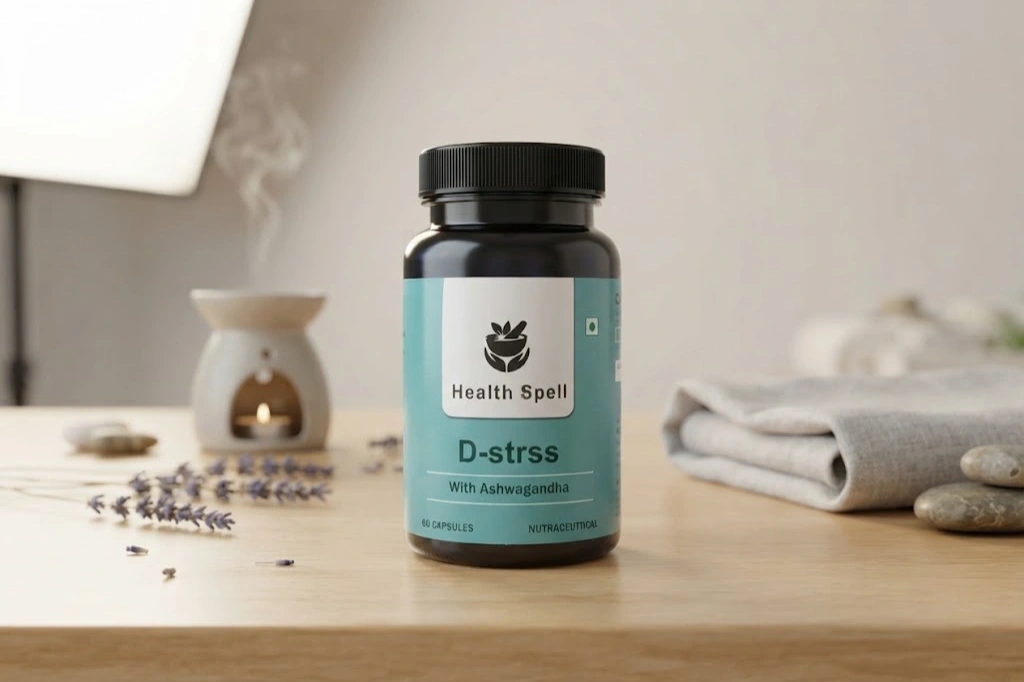
How D-Strss by Health Spell Nepal Supports Your Daily Stress Response
D-Strss with Ashwagandha is Health Spell Nepal's adaptogen-based supplement formulated to support daily stress resilience, mood balance, and mental clarity. Again, to be clear and scientifically accurate: D-Strss is a dietary supplement, not a pharmaceutical treatment for anxiety disorders or clinical depression. If you are experiencing severe, persistent mental health symptoms, please consult a qualified healthcare professional. What D-Strss is formulated for is the vast middle ground , the millions of Nepali adults who are not clinically unwell but are chronically stressed, mentally fatigued, emotionally depleted, and looking for science-backed nutritional support that works with their body's own regulatory systems rather than overriding them.
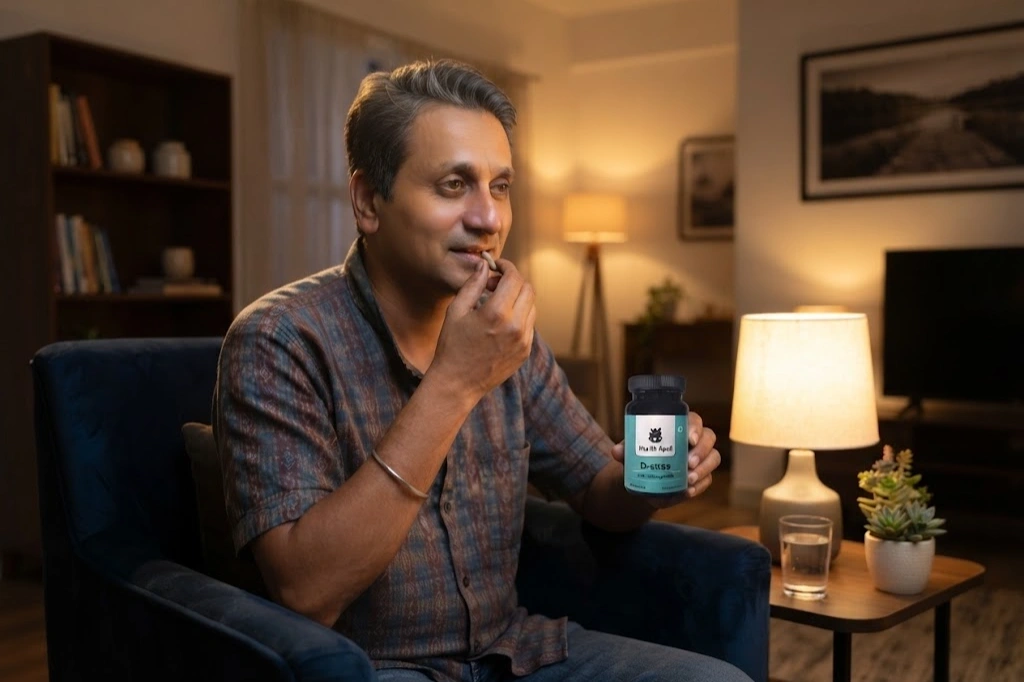
The formula is designed to:
Support the body's cortisol regulation through consistent daily use
Provide adaptogenic support that builds resilience over time rather than offering a one-time sedative effect
Help balance mood through support of the neurotransmitter systems associated with calm and positivity
Reduce mental fatigue and support clearer thinking under pressure
How to use: 1 capsule after lunch and 1 capsule after dinner (2 capsules daily). For best results, use consistently for 3 months , reflecting the timeframe used in most of the clinical studies cited above.

Who Benefits Most From Daily Adaptogen Support?
Based on the research and Nepal's specific stress landscape, D-Strss may be particularly relevant for:
Working professionals in Kathmandu and other urban centres navigating long commutes, demanding workplaces, financial pressures, and limited downtime.
Mothers and parents managing the compound stress of childcare, household responsibilities, economic concerns, and often their own suppressed emotional needs.
Students and young adults facing competitive academic environments, career uncertainty, and the psychological adjustment to urban life often far from family support systems.
Middle-aged adults (40s–60s) experiencing the compounding stressors of career pressures, ageing parents, growing children, and the early physiological changes that make stress harder to recover from.

Practical Daily Strategies to Pair With Adaptogen Support
Supplements work best within a broader lifestyle framework. Evidence-based habits that complement daily adaptogen use include:
Anchor your morning. Even 10 minutes of sunlight exposure and a protein-containing breakfast stabilises cortisol rhythms more effectively than reaching immediately for your phone.
Protect your sleep window. Sleep is the single most powerful cortisol-regulating mechanism available to you. Prioritising 7–8 hours is not a luxury; for the stressed nervous system, it is essential maintenance.
Reduce caffeine after 2 PM. Chiya culture is central to Nepali life, and this is not about eliminating it , but caffeine consumed in the afternoon measurably delays cortisol normalisation and disrupts sleep quality.
Build in transition time. Even a 5-minute walk or a few minutes of deliberate breathing between work and home life helps signal to the nervous system that the threat state is over.
Connect socially with intention. Nepal's strength in community and family bonds is a genuine protective factor for mental health , but passively scrolling through social media does not provide the same benefit as genuine human connection.
The Bottom Line
Nepal's stress epidemic is real, it is growing, and it is largely invisible because the systems to identify and address it barely exist. Approximately 3.9 million Nepalis are living with measurable mental health conditions. Anxiety affects roughly 1 in 6 adults. And the vast majority receive no support of any kind.
The science on ashwagandha is unusually robust for a plant-based compound. Multiple systematic reviews and meta-analyses using randomised controlled trial data consistently show measurable, statistically significant reductions in cortisol, perceived stress, and anxiety scores across diverse adult populations.
Daily, consistent support for your stress response system is not indulgent self-care. For the working Nepali adult navigating the pressures of modern urban life, it is a scientifically grounded investment in long-term health.
Disclaimer: Health Spell Nepal products are dietary supplements designed to support overall well-being. They are not intended to diagnose, treat, cure, or prevent any medical condition. Individual results may vary. Consult a qualified healthcare professional before beginning any new supplement routine.